
Studio-Based Creative Practices
Across Copenhagen's Nørrebro, Stockholm's Södermalm, Oslo's Grünerløkka, and Helsinki's Design District, the typical creative practice is notably compact. These are rarely sprawling design agencies with dozens of corporate account managers. More often, you find two or three partners sharing a ground-floor storefront studio where the workshop workbench sits directly behind the sketching desk.
This physical closeness between thinking and making is vital. When a designer is also the person turning the lathe or adjusting the tension of a handloom, decisions happen through the hands. If a specific Scandinavian birch species splits along a knot during turning, the designer doesn't reject it as factory waste; they reconsider the form to accommodate the grain's natural personality.
The Revival of Regional Craftsmanship
For several decades in the late twentieth century, traditional Nordic craft risked becoming an antiquarian museum curiosity. Younger generations were drawn to software and industrial mass manufacturing. Over the last decade, however, an energetic revival has taken place.
Woodcarvers, spoon carvers (*täljare*), and traditional joiners are finding fresh audiences who appreciate the durability and human presence in a hand-shaped object. Textile artists are rediscovering heritage Swedish rölakan flatweaves and Finnish *ryijy* wall tapestries, stripping away nostalgic folklore patterns in favor of clean geometric color blocks and raw, undyed wool from native sheep breeds.
Contemporary Experimentation and Bio-Materials
Nordic design has never been purely about timber and clay; it has always embraced thoughtful material science. Today's emerging independent designers are experimenting with bio-composites made of pine resin and compressed forestry bark waste, fungal mycelium acoustic wall tiles, and seaweed-derived packaging films.
What prevents these experiments from devolving into ephemeral school projects is the relentless Scandinavian demand for everyday utility. Even the most radical experimental lighting fixture or bench prototype must withstand real daily use, assemble with logical components, and offer a clear recycling path at the end of its life cycle.
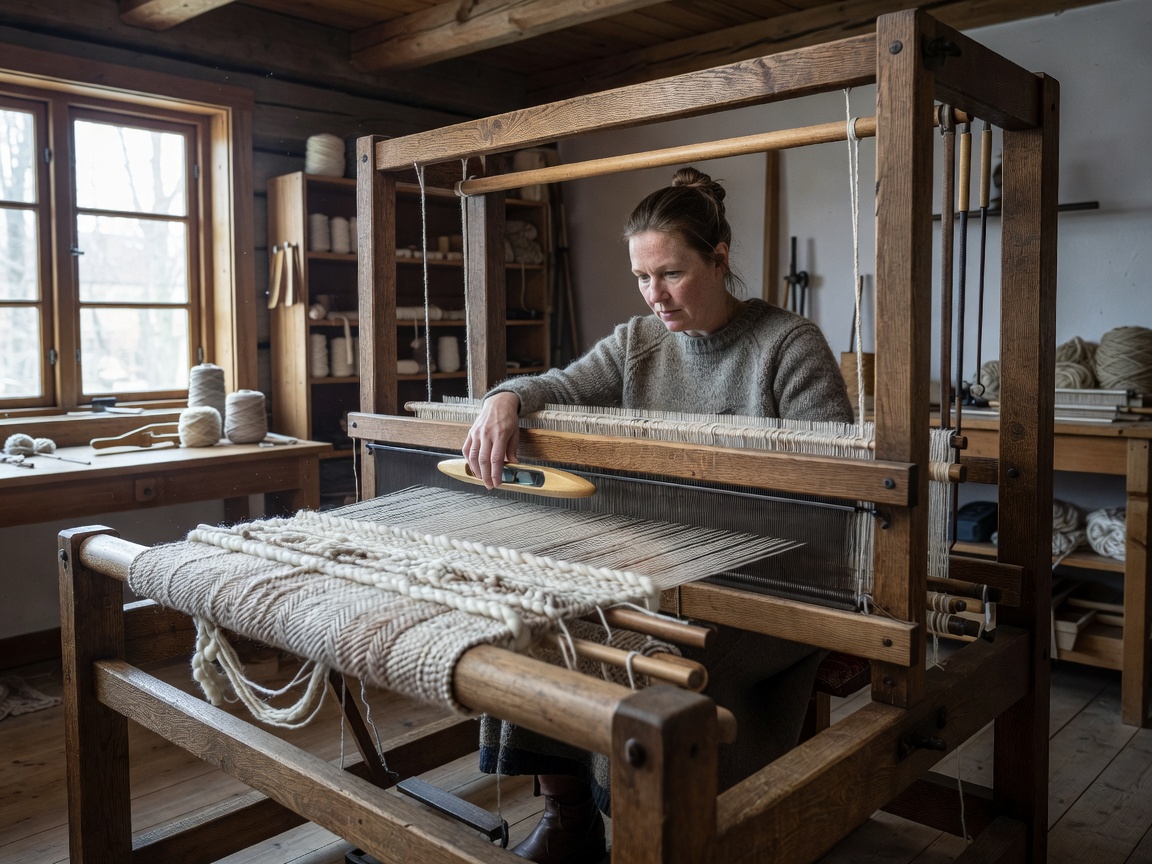
Handloom Weaving and Acoustic Textiles
Independent Nordic weavers utilize dense spun yarns from Gotland sheep to create wall hangings and throws with exceptional acoustic damping properties. Undyed fibers showcase natural variations from soft silver to deep charcoal.