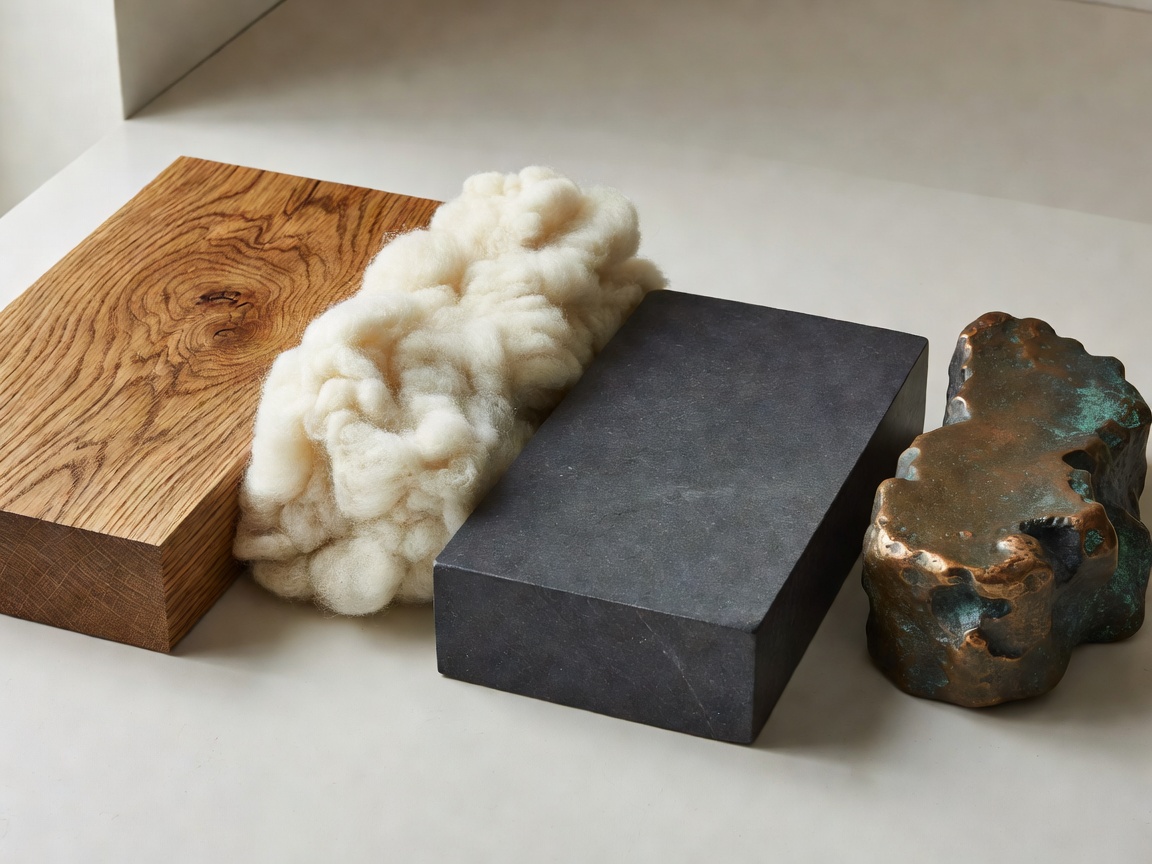
Display of architectural material swatches including oiled oak, raw wool, soapstone, and cast bronze
MAT-LEDG-011

Patina as Inherent Value

In Scandinavian design philosophy, an object that cannot age gracefully is considered flawed from the beginning. We do not look for materials that remain perpetually synthetic and frozen in time. We choose substances that take on grease, sunlight, scratches, and touch, evolving into something richer with each passing season.

MATERIAL COUNT11 Documented Elements
FINISH PRINCIPLEPermeable & Non-Film-Forming
MAINTENANCEPeriodic Soap, Wax & Natural Oils

The Eleven Foundational Substances

01

Sessile & Pedunculate Oak

Dense, highly durable European oak (*Quercus robur*) with pronounced medullary rays. Prized for its dimensional stability and resistance to denting.

  • Texture: Coarse open grain with tactile warmth.
  • Aging: Deepens from pale wheat to a rich amber-gold.
  • Maintenance: Periodic white soap or hardwax oiling.
  • Best Use: Dining table tops, chair frames, cabinetry.
02

Slow-Grown Scots Pine

Harvested from northern boreal forests where cold winters force tight annual growth rings (*Pinus sylvestris*), creating far harder timber than southern fast-grown pine.

  • Texture: Pronounced whorled knots and resinous scent.
  • Aging: Develops a warm honey patina under UV exposure.
  • Maintenance: Scrubbed regularly with lye and soap flakes.
  • Best Use: Wide plank floors, summer house wall paneling.
03

Nordic Birch

The backbone of Finnish modernism (*Betula pendula*). Pale, nearly white wood with subtle ripples that bends exceptionally well when steamed into multi-ply laminates.

  • Texture: Satiny, tight-pored, smooth surface.
  • Aging: Gently shifts toward warm pale cream.
  • Maintenance: Clear wax or waterborne matte sealers.
  • Best Use: Bentwood chair legs, stools, molded trays.
04

European White Ash

A flexible, shock-resistant hardwood (*Fraxinus excelsior*) with an elastic grain structure traditionally chosen for tool handles and steam-curved backrests.

  • Texture: Prominent feathered grain with pale contrast.
  • Aging: Retains its brightness better than oak.
  • Maintenance: White-pigmented oil finishes.
  • Best Use: Turned spindle chairs, structural dowels.
05

Nordic Fleece & Wool

Sourced from resilient Scandinavian breeds like Gotland and Røros sheep. Dense lanolin content provides natural flame retardancy and dirt resistance.

  • Texture: Crisply textured, springy, and non-static.
  • Aging: Resists pilling and retains fiber loft for decades.
  • Maintenance: Airing out in damp winter fog; spot clean.
  • Best Use: Heavy upholstery, acoustic rugs, blankets.
06

Unbleached Flax Linen

Spun from flax fibers grown across northern Europe. Breathable, cool in summer, and naturally antibacterial without chemical coatings.

  • Texture: Crisp initially, softening significantly with washing.
  • Aging: Develops a supple, gently slubbed drape.
  • Maintenance: Gentle low-temperature laundering; no press.
  • Best Use: Window drapes, cushion slips, bed coverings.
07

Vegetable-Tanned Saddle Leather

Tanned using organic tree barks (mimosa and chestnut) rather than synthetic chromium salts. Celebrated for its thick structure and natural surface markings.

  • Texture: Firm, smooth, and aromatic.
  • Aging: Transforms from pale pink-beige to dark cognac.
  • Maintenance: Annual treatment with natural beeswax balm.
  • Best Use: Sling-seat armchairs, drawer pulls, magazine caddies.
08

Nordic Granite & Soapstone

From Bohuslän granite to Finnish soapstone (*speksten*), these ancient stones hold remarkable thermal mass and natural compressive strength.

  • Texture: Honed matte to lightly textured cleft finish.
  • Aging: Soapstone darkens slightly with finger oil; timeless.
  • Maintenance: Clean with pH-neutral stone soap; no acids.
  • Best Use: Masonry heaters, fireplace hearths, kitchen islands.
09

High-Fired Stoneware

Vitrified dense clay fired at 1250°C. Non-porous and chip-resistant, often glazed in muted earth pigments derived from regional iron and wood ash.

  • Texture: Matte, lightly sandy foot rings with silky glazes.
  • Aging: Permanent; glazes never fade under sunlight.
  • Maintenance: Dishwasher safe; food-grade mineral finishes.
  • Best Use: Daily tableware, planters, sculptural vessels.
10

Mouth-Blown Soda-Lime Glass

Rooted in the Småland forest glassworks tradition of Sweden. Blown by hand into beechwood molds, giving each vessel subtle optical ripples.

  • Texture: Ultra-smooth with delicate wall thickness variations.
  • Aging: Completely inert and luminous.
  • Maintenance: Hand wash with warm water and vinegar rinse.
  • Best Use: Water carafes, lighting diffusers, candle lanterns.
11

Solid Brass & Blackened Iron

Unlacquered brass and hot-rolled carbon steel provide mechanical contrast to soft timber and wool. Left raw to interact with human hands and air.

  • Texture: Cold, dense, precision-machined or sand-cast.
  • Aging: Unlacquered brass oxidizes to rich antique bronze.
  • Maintenance: Natural patina can be left or buffed with brass wax.
  • Best Use: Door handles, light sockets, table frame bases.

The Traditional Nordic Soap Finish Protocol

One of the most distinctive Scandinavian timber treatments is the soap wash (*såpskurning*). Instead of sealing wood under plastic varnish, the timber is washed with pure white soap flakes dissolved in warm water. The soap fats penetrate the wood fibers, creating a protective barrier against spills while leaving the wood pale, velvety, and naturally matte.

To maintain a soap-treated oak or pine surface, dissolve two tablespoons of natural unscented soap flakes in one liter of warm water, let it cool to room temperature, and wipe along the grain with a cotton cloth. Wipe away excess foam and allow to dry naturally. Over months, this builds an indestructible, natural defense that smells fresh and feels unmatched to the touch.

← Volume IV: Designers Archive Contact & Registry →